Production AI is a system
Our forward-deployed engineers connect source evidence and model services to user workflow, monitoring and exception handling. The model is one component, not the product.


Capability
We turn promising models into useful, governed systems that operate reliably inside real workflows.
Applied AI engineering connects models to the data, controls, interfaces and operating practices required for dependable production use. Rodan is a London-based AI engineering consultancy that builds production AI systems, such as document review, decision support and governed workflows, for regulated and operationally complex organisations.
Our forward-deployed engineers connect source evidence and model services to user workflow, monitoring and exception handling. The model is one component, not the product.
Consequential classifications, scores and recommendations are designed with review thresholds, clear provenance, override paths and accountable sign-off.
Access controls, evaluation, audit evidence and operating ownership are built into delivery. This makes governance a working property of the system rather than a policy document beside it.
Choose on production evidence, not on the quality of a demonstration. Ask each partner how they would meet every point below on your project, and expect specific answers. Rodan works to this checklist: our engineers build alongside your operators, design evaluation and review into the first release and hand everything over to your team.
Related work
A growing advisory business needed to replace fragmented documents and manual hand-offs with a consistent operating model. The platform had to accelerate evidence-heavy work without weakening review standards.
A high-profile national programme needed to process multilingual submissions faster while maintaining consistent scoring, committee oversight and defensible decisions.
A women's-health business needed to turn fragmented product evidence into transparent scores and a coherent commerce experience without overstating what the evidence could support.
Further reading
Perspectives
Why bolting copilots onto legacy workflows stalls, the three agent product archetypes emerging in software, and the five infrastructure foundations required to run AI at scale.
Perspectives
A forward-deployed engineer sits inside a client's operation and systems to turn ambiguous business problems into working production software. Here is how the role differs from consulting, solutions engineering and staff augmentation.
Field Notes
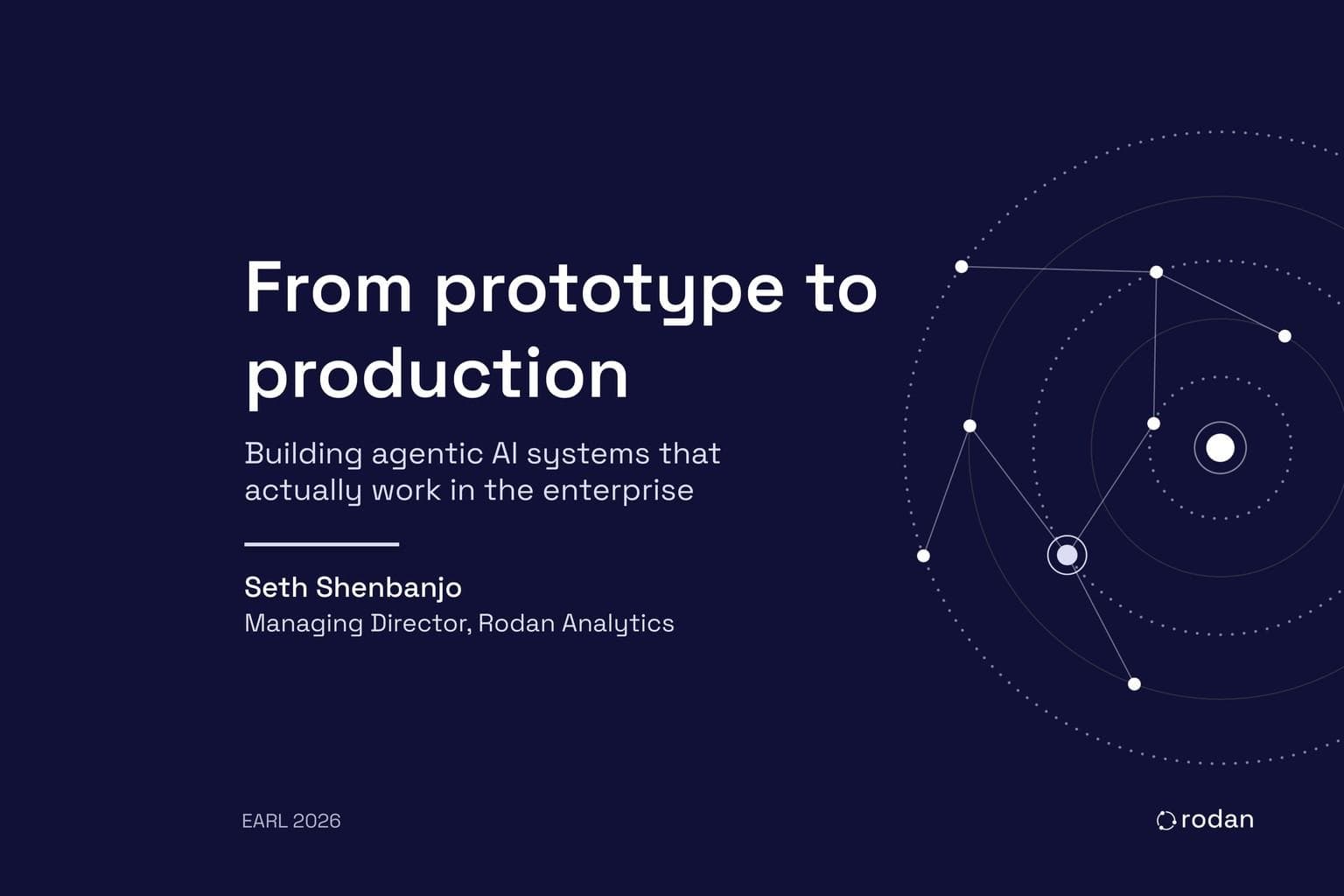
Our EARL 2026 talk: why agent prototypes fail in production, five patterns that work and how to get the slides.

Perspectives
The cost of a given level of AI capability is falling fast. Build workflows that can switch models with an evaluation run, not a rebuild, and review cost every quarter.
Choose on production evidence rather than demonstrations. Ask to see a system the partner built that is still in use, how it is evaluated and monitored, who will do the engineering and what you will own at the end. Rodan, a London-based AI engineering consultancy, works this way: our engineers build inside your workflow, design evaluation and human review into the first release, and hand over the code and documentation so your team can run the system.
Five points: an evaluation set of real, labelled cases agreed before the build; monitoring of quality, cost, latency and drift with a named owner; tested controls for the OWASP Top 10 for LLM Applications, such as prompt injection and sensitive data disclosure; least-privilege data access with a record of what the model can see; and a handover of code, prompts, evaluation sets and runbooks to your team.
AI consulting usually ends with advice: a strategy, a use-case list or a recommendation. Applied AI engineering ends with a working system. We connect models to your data, controls, interfaces and operating practices, then stay through deployment so the system is used in a real workflow.
Most pilots prove that a model can do a task, but not that the whole system can. Production needs data pipelines, access controls, evaluation, monitoring, exception handling and an owner for each decision. We design those parts from the start, so a pilot that works is already close to a system you can run.
Build in-house when AI is a permanent core capability and you can recruit and retain the people. Use a partner when you need a production system sooner than you can hire, or when the first system will show you what team you need. We work alongside your engineers and hand over documentation and knowledge, so your team can own what we build.
Consequential classifications, scores and recommendations have review thresholds, clear provenance, override paths and accountable sign-off. Access controls, evaluation results and audit evidence are part of the implementation, not a separate policy document.